A briliant post on xkcd.com today explains in one single cartoon why DRM is bad:
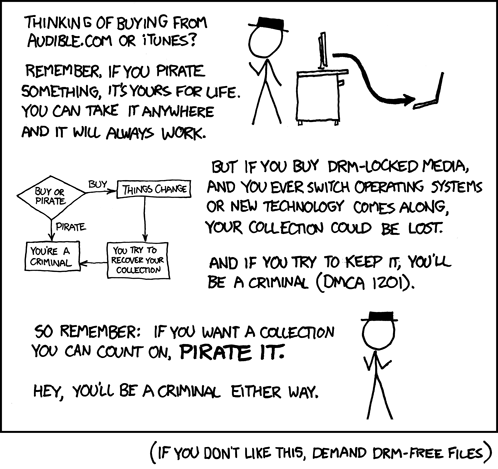
I couldn’t have made it simpler (although I tried).
Just to get this out of my system, I’ll tell you what I think of the current crisis in the monetary system. It starts off with a fictional story, and explains why we need to get rid of the monetary system, and why you should have physical gold in your safe.
The past week, I’ve heard some collegues talking about tweaking websites so that they will show up in Google search results. A lot of people actually try to figure out how to “fool” the Google search engine, and actually make a living writing books about it. The strange thing is, that a lot of people want to be the “I feel lucky” link in Google even when the search query hasn’t got anything to do with the content they’re providing.
It’s actually a funny discussion, because this behaviour which “makes use” of the system, actually breaks it. Suppose a lot of people figure out how to get this done. Now, whenever you use Google, your first page of search results will actually contain stuff you’re not looking for. After a few tries, you’ll get tired of this and start using a different search engine.
Ok so I’ve been blogging about the iPhone and it’s “apps” for a while now. After a lot of consideration and switching between Nokia and iPod touch, doing nothing and buying a 16GB 3G iPhone, I finally went for the latter. What a bittersweet experience.
I ran across this wiki page which has a nice piece on the virtues of a good programmer. I found it so recognizable that I decided to copy it over for you to enjoy:
“We will encourage you to develop the three great virtues of a programmer: laziness, impatience, and hubris.” — Larry Wall, Programming Perl (1st edition), O’Reilly and Associates
Laziness
The quality that makes you go to great effort to reduce overall energy expenditure. It makes you write labor-saving programs that other people will find useful, and document what you wrote so you don’t have to answer so many questions about it. Hence, the first great virtue of a programmer. Also hence, this book. See also impatience and hubris. (p.609)Impatience
The anger you feel when the computer is being lazy. This makes you write programs that don’t just react to your needs, but actually anticipate them. Or at least pretend to. Hence, the second great virtue of a programmer. See also laziness and hubris. (p.608)Hubris
Excessive pride, the sort of thing Zeus zaps you for. Also the quality that makes you write (and maintain) programs that other people won’t want to say bad things about. Hence, the third great virtue of a programmer. See also laziness and impatience. (p.607)
(The original context can be found at
http://c2.com/cgi/wiki?LazinessImpatienceHubris)
As I explained earlier, I think it is really important to go beyond the specs. It’s really important to put care and attention in your product. The new version of iTunes has a great (little) example of what I mean. I use Itunes to play music through both the computer speakers and a stereo in the livingroom, connected to an Airport Express.
In iTunes 7, when I added the Airport Express to the set of outputs while playing a song, the music stopped, and after a while resumed playing through all the selected outputs. I never minded the short silence, and was amazed at how Apple got all the outputs to play perfectly in sync.
In iTunes 8 things changed a tiny bit. When I select the Airport Express, the music keeps on playing on my computer, and after a few seconds the music also starts playing from the speakers in the living room. An still, the music is in sync.
It’s these little things, the amazing attention to detail, that give Apple products a tremendous “perceived value”.
That, and the Genius button ofcourse. 🙂
I had a 160GB drive holding my Time Machine backups. Because I wanted to backup external disks, and still wanted to be able to travel about a year back in time, I bought a 1TB USB disk. Stephen Foskett wrote a great article about how he migrated his TimeMachine backup to a larger disk, but it’s lengthy and misses one essential step.
I decided to give you the short version, this blog post describes how I migrated Time Machine to the new disk without losing any data in 11 easy steps.
Read More “A Bigger Time Machine without Changing History” »
I just bought a Maxtor Basics 1TB drive, and found that I could not seem to format it using the Leopard Diskutility. Then, I found this page which contained the golden tip. I’ll save you some reading:
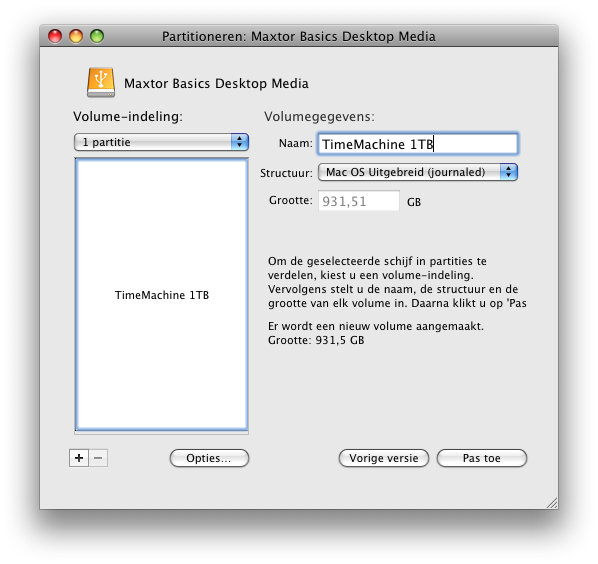
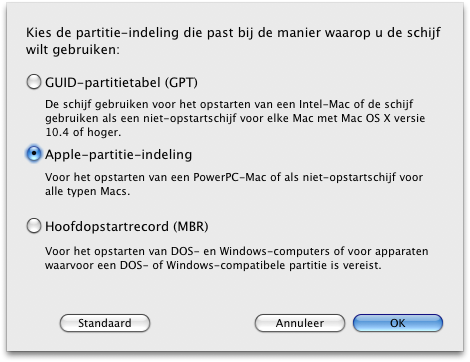
Screenshots included. It’s in Dutch, but the location of the buttons are identical for all languages.
In Windows, there is a great tool called “PureText” which sits in your tray, and can remove formatting from copy/paste actions if you want to. In stead of pasting into notepad, and then copying it again, you now can use the Windows-V combination to paste without formatting. It works in any program, and I’m a fond user of this little gem at work.
In OSX, you can do this with a key combination, Option-Shift-Command-V. Besides being the silliest and most awkward key combination ever to do a simple paste-action, it does not always do the job properly. I found this great tip where a simple applescript removes formatting from the items in your clipboard.
 This weekend was a lot of fun. Saturday night I got to fly Leo’s Walkera 60B electric helicopter. That’s one piece of impressive (and scary) machinery. Although it feels easier to fly than my 4#3B, I still “managed” to crash it. Luckaly the blades can be easily replaced, and after tightening a bunch of screws and replacing a pin in the main gear, it was good to fly again. We flew 3 times, and had to repair the helicopter after each flight 🙂 I hope I can treat you with good shots of the Walkera 60B next time, there are not many high-quality images of it online.