In my last post, I wrote about how I got HomeZone to detect my bluetooth phone, and automatically start iSync. While I was playing with it, I noticed how HomeZone opens the Address book application and iSync, and doesn’t close them. To make it more seemless, I used a script I found at The Technocrat to start and stop iSync without interfering with your work. Here’s how I did that.
Author: rolfje
HomeZone: Start iSync automatically
Recently, I installed “Do Something When” and use it to start rsync scripts when I plug in certain USB devices. By doing this, every time I plug in my USB memory stick containing my Password Gorilla password databases, it gets backed up (Apple style, with timestamps). Needless to say, it then gets backed up by TimeMachine.
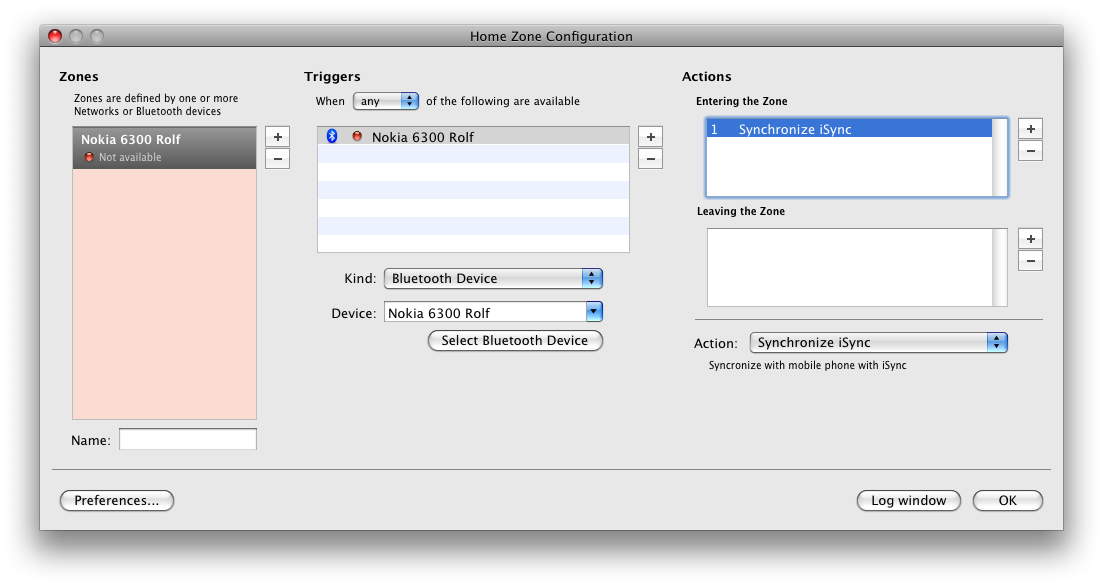 I also needed this hands-off approach for synchronizing my iCal calendar with my new Nokia 6300 phone. Enter Homezone, a very cool app that can detect if a certain Bluetooth device is in range, and start iSync. It can also lock and unlock your screen when your phone is in or out of range, respectively. I did find some buttons looking funny when running it in Leopard, but it does work fine.
Next up: a review between Busy Sync and Spanning Sync for synchronizing iCal with Google Calendar.
Stretch pants…
… invented for people who order size 12 pants for their size 18 butts.
File does not exist?
For those people who have had problems accessing their files today, I remind you of the very old saying:
“A file does not exist until it exists in two places”
Naturaly, this means on two different physical places, preferably miles apart.
Layer Violations
Like buildings, software usually a deviation of a standard structure. The architect chooses the structure his design will be based upon. After making design adjustments to the structure to cater the requirements, the architect supervises the builders. Like a building architect, the software architect supervises while walking around in the structure during the build.
Software projects can get so large and complex that the architect can not posibly monitor all the code all the time. This is where te tooling comes in. In this post, I will explain how to use Checkstyle to automatically monitor the basic architectural integrety of the software.
The vi religion
Every age has it’s tools. Many, many years ago, in 1976 to be exact, squinty-eyed nerds with a social deficiency ruled the computer world. They talked to eachother in a secret code, wore geeky clothes and made sure that everybody thought that computers were magic. To make sure that nobody could ever use a computer to edit a file, they all swore to never ever use another editor than… <scary music> vi </scary music>.
It’s not about tools; it’s about people
Last week a collegue of mine did an introductory talk about RUP (Rational Unified Process). It was an interesting talk about how RUP can be applied in projects, what the philosophy is behind RUP, and lessons learned during her first RUP workshop.
After the talk, we discussed how RUP looked a lot like DSDM, Agile and XP. In all these methods, developers are arrogant enough to “demand” customers to conform to their process. Sure there is a lot to be said for consulting the customer often, and having lots of pre-releases, but the customer is still the customer, not your in-house QA department.
DOCTYPE is a myth…
… and other wisdom from Joel. Finally, after weeks of slightly boring posts about travel, speeches and FogBugz, Joel has an article on his blog he was so famous for: Martian Headsets.
The article discusses the problems with the HTML spec, and numerous other problems developers are facing these days. That, and the Martians’ strange fascination for all kinds and shades of red.
At times, the article remembered me of some thoughts I have during my dayjob:
- Minimize. (also known as the KISS principle)
- Have a contract early in the process. Make it testable. Find a way to handle problems in the contract.
- Be strict and transparent. Fail early and explain.
- Using a standard and conforming to it are two different things.
- Communicate.
Although all are true to some degree, they aren’t going to solve all problems, because everybody has their own set of thoughts and rules. For every problem there is a nice, clean, simple, cheap, wrong answer.
Now go read the article, it’s much better than my writing…
Nokia 6300 and Apple’s iSync
 Last week, my trusty Sony Ericsson T610 became a bit awkward to use. The “down” function of the joystick finally gave up on me, after intermitting failures the past month. The only way to select the next menu item was to go “up” through all menu items. It became a pain to use, so I needed a new one.
OSX 10.5.2 Solved SMB problems (for me)
In a previous post on this blog, I indicated that the 10.5.1. update of Apple’s OSX did not fix my network and SMB problems with my Iomega drive. In the comments underneath, some readers kindly pointed out that Iomega’s K104w11 Firmware update is available for the Iomega drive I have. Now that 10.5.2 is out, I reconnected the Iomega drive to my network. And suddenly the world changed…